A mat of water hyacinth can choke a lake. The same plant can end up on a shop shelf as a woven basket. What happens between those two places determines whether it can become a viable business: can harvesters recover usable stalks, can artisans deliver consistent quality, and will buyers come back for a second order?
Part 1 explored how water hyacinth spreads and why it is so difficult to manage. Part 2 follows the harvested plant into the workshop and on to the buyer, looking at harvesting innovations, material choices, and the suppliers and artisan groups turning it into useful products.
Market Opportunity: Where Water Hyacinth Fits
Europe imported approximately US$900 million in basketry in 2024, with natural materials accounting for about 79% of import value, according to CBI’s analysis of the European basketry market. Water hyacinth is grouped with other natural materials, including seagrass, jute and abaca, so the data does not show how much of that trade came from water hyacinth. For producers, the figures point to an established market for natural-material basketry in which water hyacinth is one of several options.
For broader context, Business Research Insights’ sustainable products market forecast projects growth from US$412.12 billion in 2026 to US$803.68 billion by 2035, at a reported compound annual growth rate of 7.7%. The forecast covers a wide range of products and provides general market context; it does not measure demand for water hyacinth.
The commercial opportunity starts with a specific product and a buyer willing to pay a price that covers production and delivery. A first order shows that the product has found a buyer. Repeat orders show whether its price, quality and delivery hold up in practice.
That brings us to the next question: which form of water hyacinth suits the product you want to make?
The Purple Flower That Wasn’t a Lotus
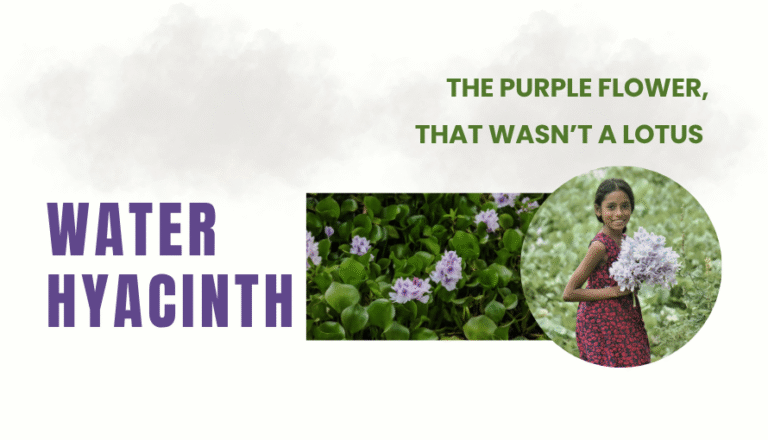
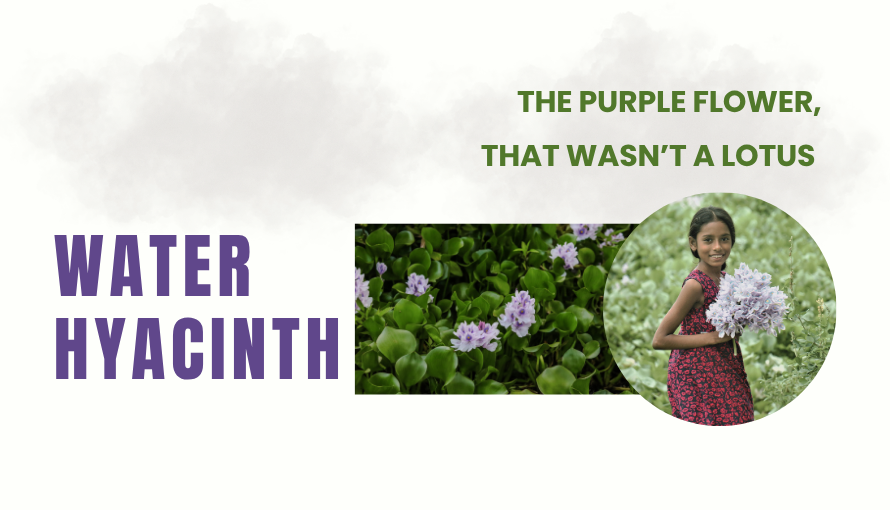
As a little girl, she stood beside the lake, longing to pick a blue lotus. The flowers farther out were beyond her reach, but a cluster floated close to the bank. She picked one, certain she had found her lotus. For years, blue remained her favourite colour. Only later did she learn the flower’s name: water hyacinth. The familiar saying, “All that glitters is not gold,” found a meaning of its own: “All that looks blue in a pond is not a lotus.”
Yet blue held another story for her—that of Neelkanth, Lord Shiva. In Hindu mythology, his throat turned blue after he held the poison that emerged during Samudra Manthan, protecting the world from its devastation. The destroyer was also the protector.
Now, looking at the beautiful plant spreading across the lake, she wondered: could something harmful hold the possibility of something helpful?
The Plant Behind the Flower
Water hyacinth is a floating freshwater plant native to South America. Its accepted scientific name is Pontederia crassipes Mart., although the synonym Eichhornia crassipes (Mart.) Solms remains widely used. It belongs to the Pontederiaceae family and is botanically distinct from both the lotus and the garden hyacinth. Its flowers range from blue to pale purple.
The name “hyacinth” also carries a connection to Greek mythology. In the story of Hyacinthus, Apollo accidentally causes the death of a young man he loves, and a flower springs from the young man’s blood. This is a cultural association with the name, rather than an account of water hyacinth’s botanical origin.
For a detailed understanding of invasive plants, their biology and management, refer to Invasive Species: A Handbook, published by the Indian Council of Forestry Research and Education (ICFRE).
How Water Hyacinth Reached India
Water hyacinth was introduced to India as an ornamental plant during British colonial rule. Research commonly places its introduction to Bengal around 1896. A loving husband brought this flower to India to make his wife happy. Yes, the story is often associated with Lady Hastings, the wife of the first Governor-General, who was charmed by its beauty.
Water hyacinth is commonly known in India as Jalkumbhi (Hindi/Nepali) and Kochuripana (Bengali). Due to its rapid, destructive spread in water bodies, it is popularly called the “Terror of Bengal” or the “Beautiful Blue Devil”.
When Rapid Growth Chokes a Lake
Water hyacinth can double its biomass in roughly one to two weeks under favourable conditions—and in as little as five days under ideal conditions. If it doubled every seven days, 10 kg could theoretically become 160 kg in four weeks, although temperature, nutrients and crowding influence actual growth.
What begins as a patch of green can become a dense floating mat, blocking sunlight from underwater vegetation and lowering dissolved oxygen. As accumulated plant material decomposes, it consumes more oxygen, putting fish and other aquatic life under pressure.
The consequences reach beyond the water. Boats struggle to pass, fishing becomes difficult, and access narrows. Clearing requires labour, equipment and repeated effort as plants regrow. A lake that looks lush can leave the surrounding community with fewer opportunities and mounting costs.
Biological Multiplication: Understanding Exponential Growth:
What could happen if a population of 10 water hyacinth plants doubled every 15 days? Over 360 days—approximately 12 months—the mathematical result would be 167,772,160 plants.
This demonstrates exponential growth: newly formed plants also reproduce, allowing the population to increase progressively faster.
The example assumes constant doubling, no plant losses and unlimited space and resources. Actual growth depends on temperature, nutrient availability, crowding and management. The 15-day interval is an illustrative assumption, not a universal growth rate or a prediction for a particular lake.
Plant count, biomass and surface coverage are different measurements. This calculation cannot establish how much of a lake the plants would cover, but it helps explain why early management matters.
The Economic Cost of Invasive Aquatic Plants
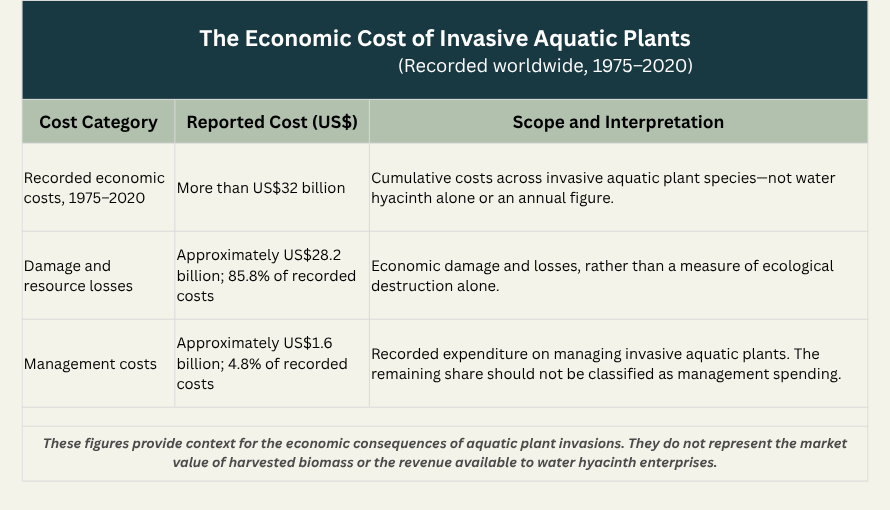
The consequences of aquatic plant invasions also appear in economic records. A study published in 2024, led by researchers at the Leibniz Institute of Freshwater Ecology and Inland Fisheries (IGB) and Queen’s University Belfast’s Institute for Global Food Security, analysed records from the InvaCost database.
It identified more than US$32 billion in recorded economic costs associated with invasive aquatic plants worldwide during 1975–2020. Damage and resource losses accounted for approximately US$28.2 billion, or 85.8%, while management costs totalled approximately US$1.6 billion, or 4.8%. The remaining share should not be classified as management expenditure.
For deeper insights into the economic costs and ecological impacts of invasive aquatic plants worldwide, refer to Nadja Neumann’s article, “High economic damage caused by invasive aquatic plants worldwide,” published by the Leibniz Institute of Freshwater Ecology and Inland Fisheries (IGB).
From Lake to Loom: What Skilled Hands Can Make
Against this background, using harvested material offers a different question: what useful purpose might it serve after removal?
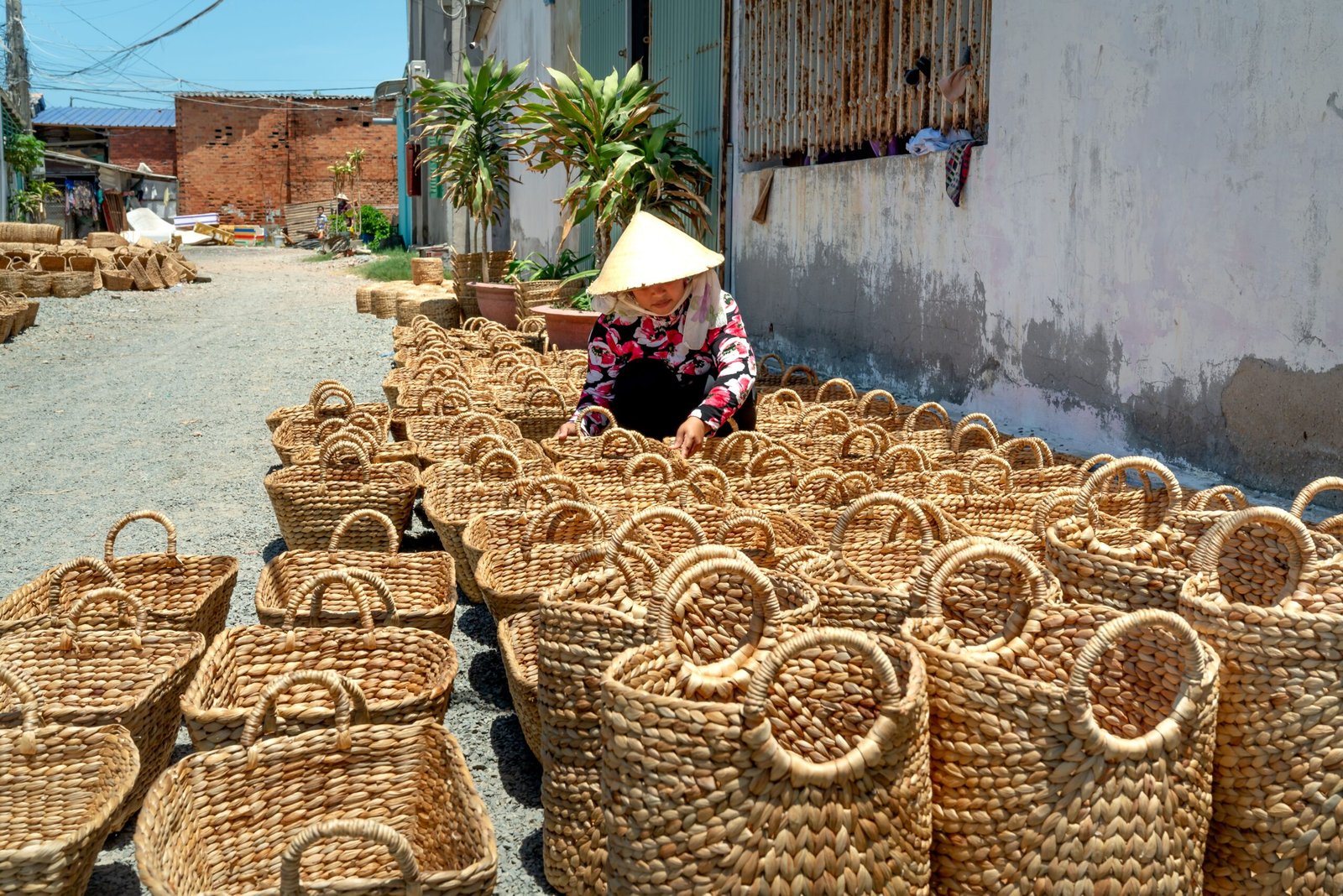
The transformation begins with the plant’s long leaf stalks, often called stems. Artisans harvest, clean and sort them, then dry them thoroughly. This step matters: excess moisture can compromise shape, quality and storage. Once prepared, the stalks are flattened, twisted or braided before being woven into useful objects.
Across craft communities in Asia, Africa and beyond, these techniques turn water hyacinth into baskets, handbags, trays, placemats, floor mats and decorative accessories. Woven around supporting frames, it also becomes furniture surfaces and lampshades. From floating stalk to finished basket, careful preparation and skilled hands give the material a new purpose.
Who is turning this possibility into purposeful products? Explore selected enterprises and artisan initiatives transforming invasive water hyacinth into thoughtfully crafted goods, connecting design with livelihood opportunities and productive use of harvested material.
[INTERNAL LINK PLACEHOLDER: Part 3—Meet the Enterprises Turning Water Hyacinth into Purposeful Products]
More Than Baskets
Beyond weaving, water hyacinth has applications in handmade paper and compost, alongside research into biogas and other biomass conversions. Its ability to absorb certain pollutants has also attracted interest in controlled water-treatment systems. However, contaminants accumulated in the plant remain a concern after harvesting.
Material from polluted water requires source assessment and appropriate testing before reuse, particularly in agriculture or products involving contact with people or food. Composting does not destroy heavy metals. A promising application does not establish that every batch is suitable—or that the process is commercially viable. These require separate assessment before production expands.
Beyond baskets, water hyacinth connects emerging technology with traditional knowledge. A proposed project in Kenya aims to turn water hyacinth and sugarcane bagasse into biogas, electricity and organic fertiliser, while farmers in Bangladesh use floating beds made from water hyacinth and other plant residues to grow crops in waterlogged areas. INTERNAL LINK PLACEHOLDER: Explore these two approaches in Part 2: Beyond Handicrafts.
Natural, but Not Automatically Sustainable
A natural ingredient alone does not establish the environmental performance of a finished product. Processing, transport, coatings, adhesives and supporting materials all influence the result.
Untreated plant material can biodegrade under suitable conditions, while a finished composite containing synthetic resin may require a different disposal route. Claims about biodegradability or compostability need to identify the relevant conditions and cover the complete product.
Material transparency helps buyers understand these differences. A basket made with a metal frame, a coated paper sheet and an untreated woven mat may all contain water hyacinth, yet their performance and disposal options differ.
How does this transformation work in practice? Part 2 explores material forms, harvesting technologies and the enterprises and artisan initiatives turning water hyacinth into products.
[INTERNAL LINK PLACEHOLDER: Part 2—Understanding Water Hyacinth: Species, Material Forms and Technical Properties]
Made to Last with the Right Care
Water hyacinth products have no universal lifespan. Durability depends on preparation, weaving, reinforcement, finishing and the conditions in which the product is used.
For many woven goods, avoiding prolonged dampness is a practical starting point. Gentle dusting, avoiding soaking and prompt drying after accidental dampness can help preserve the material. Product-specific instructions should take priority, especially where coatings, linings or supporting frames are present. Lifespan claims should rest on testing or documented experience. A well-prepared indoor basket and an outdoor product exposed to rain require different expectations.
Beyond the Blue Flower
A plant that overwhelms a lake can become a useful everyday object—but the journey takes more than harvesting. Collection, transport, cleaning, drying and storage all carry costs. For artisans to earn a dependable livelihood, these activities need an organised supply chain, fair payment and buyers who return.
An artisan cluster can bring that organisation: shared drying facilities, tools, training and quality standards, supported by coordinated sourcing and production. Designers can help turn traditional skills into practical products, while research and development explore new applications in paper, packaging and fibre-based materials. Each promising idea must move beyond the laboratory to prove its safety, durability, affordability and suitability for everyday use.
Could some of these materials replace plastic? Potentially, in selected applications where testing demonstrates comparable performance and a better environmental outcome. Plastic substitution requires attention to the whole product: synthetic coatings, adhesives or resins may limit biodegradability, and replacing plastic does not remove pollution already in the environment.
The little girl once mistook a blue flower for a lotus. Her next discovery could be more hopeful: with careful research, skilled hands and responsible enterprise, a troublesome plant can find a useful place in everyday life.
Continue the Journey
[INTERNAL LINK PLACEHOLDER: READ PART 2]
Click here for Part 2: From Material Potential to Commercial Reality
What does it take to turn an invasive plant into a product buyers want? Explore harvesting innovations, material forms, technical properties and buyer checks, alongside a curated list of suppliers and artisan initiatives turning water hyacinth into useful goods.
Click here for Part 3: From Workshop to Destination
What does a water hyacinth product really cost by the time it reaches an international buyer? Explore import and export requirements, testing, packaging and logistics, with a worked hypothetical example covering production losses, sea freight, customs clearance, duties and delivery.
“Hey reader, I’ve poured my experiences and thoughts into this blog with the hope of sparking curiosity and conversation.
If this resonated with you, or if you share similar interests, I’d be delighted to continue the conversation. Your feedback truly means a lot.
Feel free to drop me a message or visit my website for more stories and insights.“